Given a collection of integers that might contain duplicates, return all possible unique permutations. For example:
Input:[1, 2, 2]
Output:
text
[ [1,1,2], [1,2,1], [2,1,1],]
The subsets problem and the permutations problem are both classic backtracking problems, and we covered their detailed approaches and solutions in the previous article. The problems in this lesson are variations of those — both involve duplicate elements in the input, and we need to avoid producing duplicate results. This article assumes you are already familiar with the approaches and solutions for subset, permutation, and combination problems. If you are not yet clear on the solutions for these problems, I recommend reading the previous article first: LeetCode Problem Deep Dive | 08 Permutations and Combinations: Candidate Sets in Backtracking.
Both of these problems test pruning strategies in backtracking. Pruning essentially means removing certain branches from the decision tree so they are not explored. We need to think about how to eliminate duplicate results based on the nature of the problem, and how to implement deduplication as pruning on the decision tree.
This article will cover the deduplication strategies, pruning approaches, and solution code for the subsets, permutations, and combinations problems.
Subsets with Duplicate Elements
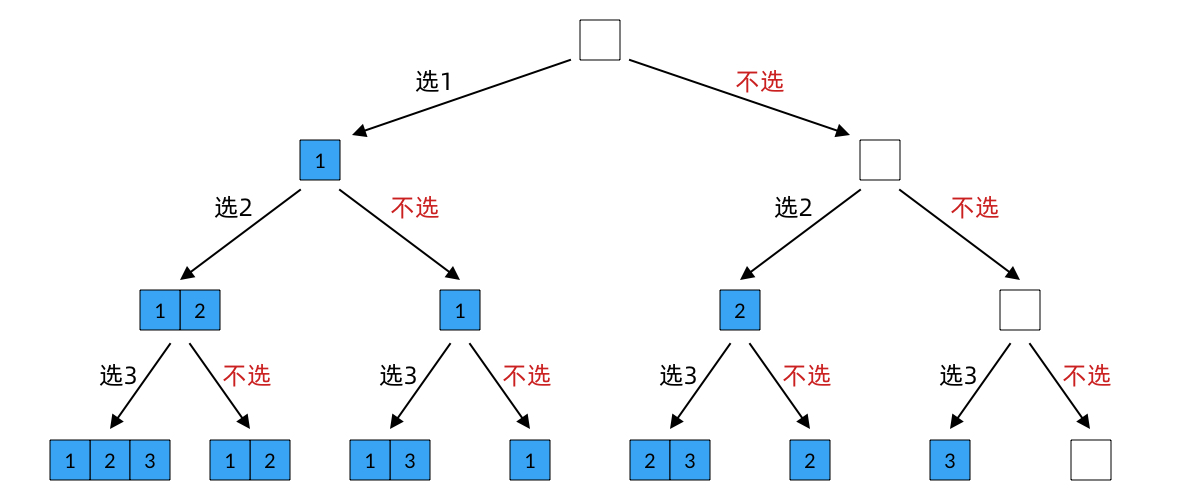
Let’s first review the decision tree for the subsets problem. Backtracking involves n decisions in total, and each decision has two branches — whether or not to include the i-th element in the subset. Taking [1,2,3] as an example, the decision tree looks like the figure below.
Decision tree for the subsets problem
The solution code is as follows:
java
public List<List<Integer>> subsets(int[] nums) { Deque<Integer> current = new ArrayDeque<>(nums.length); List<List<Integer>> res = new ArrayList<>(); backtrack(nums, 0, current, res); return res;}// Candidate set: nums[k..N)void backtrack(int[] nums, int k, Deque<Integer> current, List<List<Integer>> res) { if (k == nums.length) { res.add(new ArrayList<>(current)); return; } // Do not select the k-th element backtrack(nums, k+1, current, res); // Select the k-th element current.addLast(nums[k]); backtrack(nums, k+1, current, res); current.removeLast();}
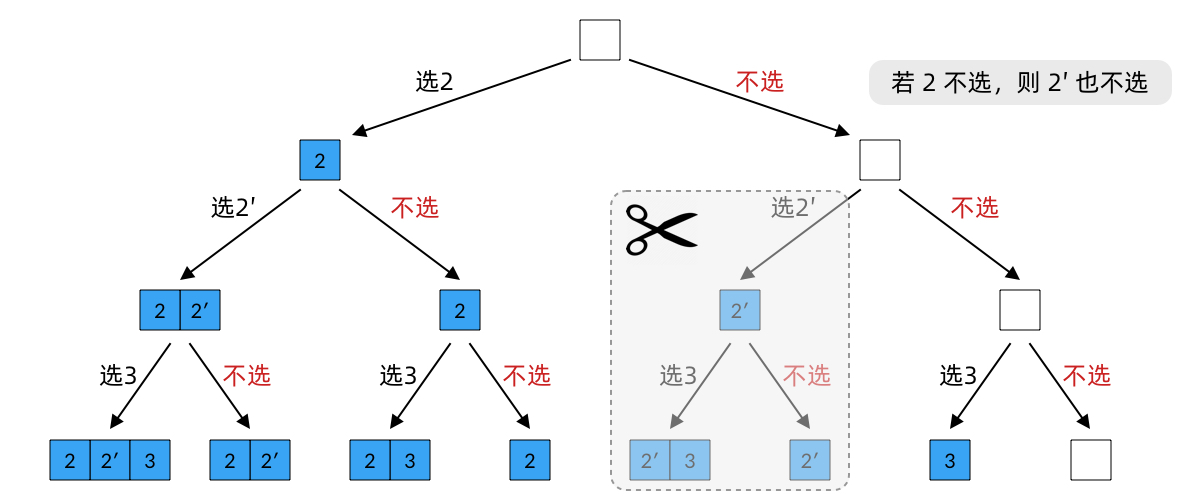
So, when the input contains duplicate elements, how do we eliminate duplicate results? Let’s find the approach through a concrete example. Take the input [1,2,2,2] — [1,2,2] is one of its subsets. To distinguish the duplicate 2s, let’s label the three 2s as 21, 22, and 23. Then the subset [1,2,2] could be [1,21,22], [1,21,23], or [1,22,23]. Among these three duplicate results, we only need to keep one.
We can establish a rule: in a consecutive sequence of 2s, if the first 2 is not included in the subset, then none of the subsequent 2s can be included either. In other words, if we don’t select 21, then we cannot select 22 or 23. This way, to have two 2s in the result, the only possibility is 21 and 22. Deduplication achieved! The corresponding decision tree pruning is shown in the figure below.
Decision tree pruning for subsets with duplicate elements
How do we translate this pruning logic into code? Two things are needed:
Before backtracking, sort all elements in the array so that equal elements are adjacent;
Each time we decide on element x, if we choose not to select candidate element x, then we also skip all consecutive equal elements that follow x.
Here is the solution code. As you can see, the pruning logic is implemented by removing multiple elements from the candidate set at once. The concept of the candidate set also plays an important role in understanding “pruning.”
java
public List<List<Integer>> subsetsWithDup(int[] nums) { // Sort elements to ensure equal elements are adjacent Arrays.sort(nums); Deque<Integer> current = new ArrayDeque<>(nums.length); List<List<Integer>> res = new ArrayList<>(); backtrack(nums, 0, current, res); return res;}// Candidate set: nums[k..N)void backtrack(int[] nums, int k, Deque<Integer> current, List<List<Integer>> res) { if (k == nums.length) { res.add(new ArrayList<>(current)); return; } // Select nums[k] current.addLast(nums[k]); backtrack(nums, k+1, current, res); current.removeLast(); // Do not select nums[k] // Remove all subsequent elements equal to nums[k], i.e., nums[k..j), from the candidate set int j = k; while (j < nums.length && nums[j] == nums[k]) { j++; } backtrack(nums, j, current, res);}
Permutations with Duplicate Elements
The permutations problem with duplicate elements follows a very similar idea to the subsets problem, except that due to the different backtracking approach, the code looks somewhat different. Let’s first review the original code for the permutations problem:
java
public List<List<Integer>> permute(List<Integer> nums) { List<Integer> current = new ArrayList<>(nums); List<List<Integer>> res = new ArrayList<>(); backtrack(current, 0, res); return res;}// current[0..k) is the selected set, current[k..N) is the candidate setvoid backtrack(List<Integer> current, int k, List<List<Integer>> res) { if (k == current.size()) { res.add(new ArrayList<>(current)); return; } // Choose from the candidate set for (int i = k; i < current.size(); i++) { // Select number current[i] Collections.swap(current, k, i); // Increment k backtrack(current, k+1, res); // Undo the selection Collections.swap(current, k, i); }}
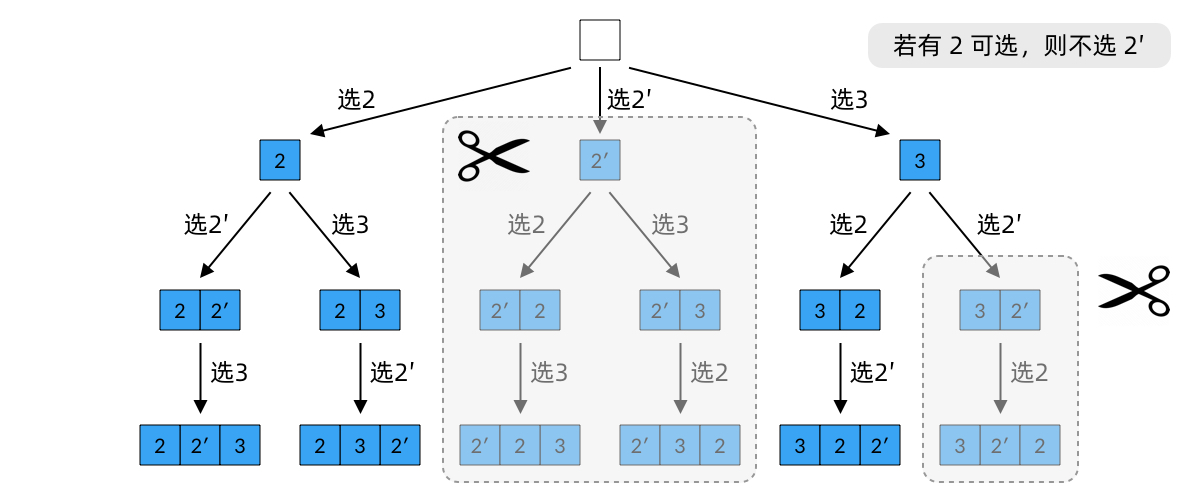
For the permutations problem with duplicate elements, let’s again think about the pruning strategy using the input [1,2,2,2]: label the three 2s as 21, 22, and 23. For the permutation [1,2,2,2], it could actually be [1,21,22,23], [1,21,23,22], [1,22,21,23], [1,22,23,21], [1,23,21,22], or [1,23,22,21] — 6 possibilities in total. How should we prune to keep only one of these results?
We can establish a rule: if there are multiple candidate 2s, we can only select the first 2; the remaining 2s cannot be selected this time. In other words, the three 2s must be selected in order — first 21, then 22, and finally 23 — so that only the arrangement 21,22,23 is a valid result. Deduplication achieved! The corresponding decision tree pruning is shown in the figure below.
Decision tree pruning for permutations with duplicate elements
However, for the permutations problem, we cannot guarantee that equal elements remain adjacent simply by sorting the original array. During backtracking, various swap operations break the original adjacency relationships. So we need to use a set to help determine whether a candidate element has appeared before.
Here is the solution code. As you can see, the pruning logic is implemented by skipping certain elements in the candidate set.
java
public List<List<Integer>> permuteUnique(List<Integer> nums) { List<Integer> current = new ArrayList<>(nums); List<List<Integer>> res = new ArrayList<>(); backtrack(current, 0, res); return res;}// Selected set current[0..m), candidate set current[m..N)void backtrack(List<Integer> current, int m, List<List<Integer>> res) { if (m == current.size()) { res.add(new ArrayList<>(current)); return; } // Use a set to check whether an equal candidate element has already appeared. Set<Integer> seen = new HashSet<>(); for (int i = m; i < current.size(); i++) { int e = current.get(i); if (seen.contains(e)) { // If an equal element has already appeared, skip this element continue; } seen.add(e); Collections.swap(current, m, i); backtrack(current, m+1, res); Collections.swap(current, m, i); }}
Combinations with Duplicate Elements
The combinations problem doesn’t have a direct corresponding problem on LeetCode, but for the sake of completeness, let’s continue our discussion after subsets and permutations and think about how to solve the combinations problem with duplicate elements. As before, let’s first review the solution code for the combinations problem:
java
public List<List<Integer>> combine(List<Integer> nums, int k) { Deque<Integer> current = new ArrayDeque<>(); List<List<Integer>> res = new ArrayList<>(); backtrack(k, nums, 0, current, res); return res;}// current is the selected set, nums[m..N) is the candidate setvoid backtrack(int k, List<Integer> nums, int m, Deque<Integer> current, List<List<Integer>> res) { // When the selected set reaches k elements, collect the result and stop selecting if (current.size() == k) { res.add(new ArrayList<>(current)); return; } // Choose from the candidate set for (int i = m; i < nums.size(); i++) { // Select number nums[i] current.addLast(nums.get(i)); // Elements nums[m..i) are invalidated backtrack(k, nums, i+1, current, res); // Undo the selection current.removeLast(); }}
In fact, the deduplication approach we discussed for the permutations problem can be directly applied to the combinations problem. Their pruning strategies are exactly the same!
Taking the input [1,2,2,2] as an example, following the same approach as the permutations problem, we establish the rule: if there are multiple candidate 2s, we can only select the first 2; the remaining 2s cannot be selected this time. In other words, if the result contains only one 2, it can only be 21; if the result contains two 2s, they can only be 21 and 22.
When translating this approach into code, the combinations problem is actually much simpler than the permutations problem. This is because the combinations problem doesn’t involve swap operations that disrupt element ordering. We just need to sort the array at the beginning, and then we can easily determine whether an element is the first among its equal peers. The solution code is as follows:
java
public List<List<Integer>> combine(int[] nums, int k) { // Sort elements to ensure equal elements are adjacent Arrays.sort(nums); Deque<Integer> current = new ArrayDeque<>(); List<List<Integer>> res = new ArrayList<>(); backtrack(k, nums, 0, current, res); return res;}// current is the selected set, nums[m..N) is the candidate setvoid backtrack(int k, int[] nums, int m, Deque<Integer> current, List<List<Integer>> res) { // When the selected set reaches k elements, collect the result and stop selecting if (current.size() == k) { res.add(new ArrayList<>(current)); return; } // Choose from the candidate set for (int i = m; i < nums.length; i++) { if (i > m && nums[i] == nums[i-1]) { // nums[i] equals the previous element, meaning it's not the first occurrence among equals — skip it. continue; } // Select number nums[i] current.addLast(nums[i]); // Elements nums[m..i) are invalidated backtrack(k, nums, i+1, current, res); // Undo the selection current.removeLast(); }}
Summary
In a single article, we’ve covered the duplicate-element versions of the subsets, permutations, and combinations problems. As you can see, their approaches are all very similar. To summarize, this category of backtracking problems requiring deduplication can all follow these steps:
First, write the duplicate-free version of the problem correctly (this is important!);
Think about the pruning strategy — typically removing or skipping certain elements in the candidate set;
Based on the characteristics of the code, add specific pruning checks, either using pre-sorting or leveraging data structures.
The solution code for this lesson’s problems may look simple, but it still takes practice to become proficient. The difficulty of backtracking problems lies not only in the problem-solving approach but also in writing clear, understandable, bug-free code. Practice often and refine your code — that’s the key to mastering backtracking problems.
Originally published onWeChat Official Account: FUTURE CODER 未来开发者,
View original
。